 how-to
7 Steps to Compare Home Inspection Reports Before You Commit
Last Updated: October 25, 2026
Quick Summary
To compare home inspection reports, build a worksheet with one row per finding and normalize each inspector's severity labels onto one scale: safety, major, maintenance, or monitor. Then sort findings into agreements, gaps, and conflicts, and send a specialist to settle any true condition conflict.
- Compare the underlying condition, not the labels, since one inspector's monitor often equals another's maintenance item.
- Check scope and limitations first, because a report with fewer findings may simply have seen less.
- Sort every finding into safety, major defect, or maintenance, then rank within each bucket by cost and urgency.
- A true condition conflict needs a specialist, while an access gap may only need a reinspection.
- A standard inspection takes 3 to 4 hours, so a large home with very few findings deserves a question.
Table of Contents
- Why Comparing Home Inspection Reports Matters
- Your Home Inspection Report Checklist for a Side-by-Side Comparison
- Home Inspection Report Examples: What a Good One Looks Like
- How to Prioritize Home Inspection Findings
- Home Inspection Report Red Flags to Watch For
- What to Do When Two Reports Conflict or Omit Information
- Get an Independent Inspection You Can Compare with Confidence
- Frequently Asked Questions
Why Comparing Home Inspection Reports Matters
Two inspection reports on the same house can read like they describe two different properties. One calls the roof "serviceable." The other flags it for replacement. Neither inspector is lying.
That gap is why knowing how to compare home inspection reports matters more than most buyers expect. A report is not a verdict. It is one professional's visual, non-invasive observations, written in that inspector's language, sorted by that inspector's judgment.
At Integrity Inspection Service, we have watched buyers get rattled by a single scary line while missing a pattern that showed up in three sections. Here is how to line up reports, what to check first, and what to do when they disagree.
Your Home Inspection Report Checklist for a Side-by-Side Comparison
A useful comparison starts with a written worksheet, not a gut feeling. Most buyers open two reports, read the scariest line in each, and freeze. The worksheet below forces you to compare like with like.
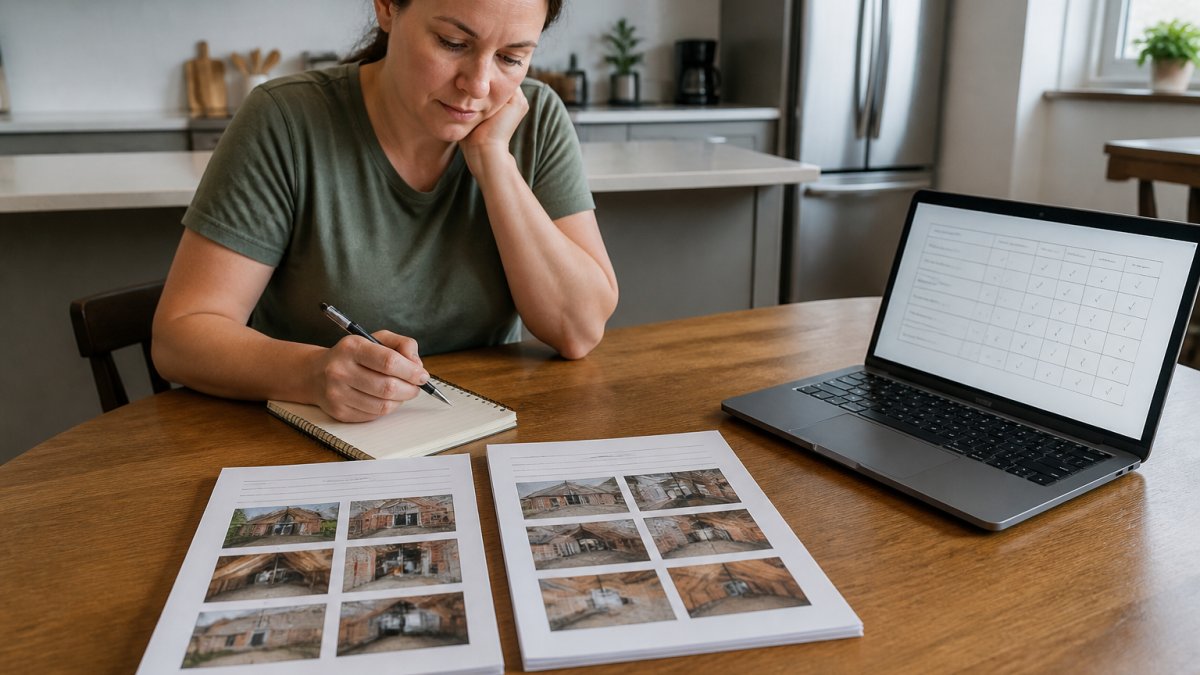
Build one row per finding, not one row per report. That single change is what separates a real comparison from a vibe check.
The Comparison Worksheet
Use a spreadsheet or a sheet of paper with these columns. Fill in one row for each finding that appears in either report.
| Column | What to write | Why it matters |
|---|---|---|
| System | Roof, electrical, plumbing, HVAC, structure, exterior, interior | Groups findings so you compare the same system across reports |
| Condition described | The plain-language condition, not the label | Lets you match findings even when the wording differs |
| Report A severity | The exact label Report A used | Preserves the original wording for reference |
| Report B severity | The exact label Report B used | Preserves the original wording for reference |
| Normalized severity | Safety / major / maintenance / monitor | Puts both reports on one scale you control |
| Evidence | Photo, measurement, or narrative | Tells you which report documented the condition better |
| Recommended action | Repair, further evaluation, monitor, none | Shows whether the two inspectors agree on next steps |
| Open question | What you still need to confirm | Becomes your follow-up list |
Both reports describing the same condition at the same normalized severity is an agreement. Only one report mentioning it is a gap. Both mentioning it but disagreeing on severity is a conflict. Sort your rows into those three buckets and the negotiation picture gets clearer.
Normalize the Rating Scales Before You Compare
Different inspectors use different severity rating scales, a color code, numbers, or plain sentences with no rating at all. Compare the labels directly and you will draw the wrong conclusion.
Write down what each scale means before you open the second report.
Do not compare the labels. Compare the underlying condition. If both reports describe the same loose handrail, they agree, even if one files it under safety and the other under minor defects.
Scope and Limitations to Check First
Scope is the first thing to compare, because a narrow inspection will always look cleaner.
Look for the inspection limitations section in both reports. Was the roof walked, viewed from the ground, or not viewed at all? Was the electrical panel opened?
Tennessee is a licensed state, so start by confirming both inspectors hold a current license at Tennessee's license verification portal.
Comparing Reports for Different Properties
If you are weighing two houses, the worksheet still works, but adjust before you judge which property has fewer concerns. A 1950s crawl-space home and a 2015 slab-on-grade home are not comparable on raw finding counts.
Adjust for these before you compare totals:
- Age. Older homes carry more deferred maintenance and more end-of-life systems. A longer list is expected, not automatically worse.
- Size and complexity. More square footage, more systems, and more roof planes mean more findings. Compare findings per system, not raw counts.
- Construction type. Crawl space versus slab, basement versus no basement, and masonry versus siding each change what an inspector can see and what tends to fail.
Compare the two properties system by system using the normalized severity column. A house with three safety items and two major defects is a different conversation than a house with one safety item and eight maintenance items, even if the total row count is similar.
For a deeper look at what to watch for while the inspection is happening, see our guide on what to look for during a home inspection as a buyer.
Home Inspection Report Examples: What a Good One Looks Like
A good report reads like a prioritized punch list, not a novel. It separates safety hazards from major defects from routine upkeep. It includes photos with each finding and a clear recommended next step.
Here is what separates a strong home inspection report from a weak one:
| Element | Strong Report | Weak Report |
|---|---|---|
| Summary | Top issues ranked by risk | Long unranked list |
| Findings | Grouped by home system | Random order |
| Photos | Attached to each issue | Few or none |
| Language | Plain, specific | Jargon-heavy |
| Next steps | Clear recommendation | Vague or missing |
When you compare reports, this table is your filter. A report that fails three or more rows is hard to weigh against a stronger one. You can still use it, but lean on the report that documents better.
How to Prioritize Home Inspection Findings
Sort every finding into three buckets: safety, major defect, and maintenance. Then rank within each bucket by cost and urgency. That order becomes your negotiation list.
Safety Hazards vs. Major Defects vs. Maintenance
Safety hazards come first, every time. Exposed wiring, a failed gas connection, a missing stairwell handrail, or a blocked flue are not negotiating chips.
Major defects come second. A roof at the end of its life, an actively moving foundation crack, or an HVAC system that will not keep up are big-ticket items.
Maintenance items come last, but do not skip them. Tennessee standards do not require inspectors to report minor items. We include them anyway, because small things add up.
Once you have your priorities sorted, the next question is how to turn them into a conversation with the seller. Our guide on how to negotiate repairs after a home inspection walks through that step.
Home Inspection Report Red Flags to Watch For
Some problems are not in the findings. They are in the report itself.
Watch for these home inspection report red flags:
- No photos, or photos that do not match the description
- A summary that contradicts the detailed findings
- Large sections marked "not inspected" with no reason given
Watch out: a report with almost no findings is not automatically good news. It can mean the inspector had limited access, rushed the job, or left out small items they were not required to report. A standard inspection takes 3 to 4 hours. If a report on a large home arrived suspiciously fast with very little in it, ask why.
What to Do When Two Reports Conflict or Omit Information
When reports conflict, do not pick the scarier one and do not average them. Find the underlying condition, then get a specialist to settle it. The hard part is knowing which kind of disagreement you are looking at, because a terminology conflict and a true condition conflict call for different next steps.
Sort the Disagreement Before You Act
Use this decision tree. It keeps you from paying for a specialist evaluation you do not need, and from skipping one you do.
- Is it a wording difference? Both reports describe the same condition but use different labels. Example: one says "monitor," the other says "maintenance item." This is not a conflict. Normalize the labels and move on.
- Is it a scope difference? One inspector looked at the system and the other did not, or one had access the other lacked. Example: one entered the crawl space, the other noted standing water and did not enter. This is an access gap, not a disagreement about condition. The report with less access is the weaker source on that system.
- Is it a true condition conflict? Both inspectors looked at the same system and reached different conclusions. Example: one calls the roof serviceable, the other recommends replacement. This is the one that needs a specialist.
- Is it an omission? One report mentions a condition and the other says nothing. Treat the silence as an open question, not as agreement that the condition is fine.
Isolate the Disagreement in Writing
Write the exact condition each report describes, in plain language, without the labels. "Roof shingles show granule loss and lifted tabs" is a condition; "Roof: monitor" is a label.
Keep the specialist's written opinion with both reports. In a negotiation, a roofer's written assessment carries more weight than either inspector's visual observation, because the specialist can test and measure what a general inspector can only see.
When to Ask for a Reinspection
A reinspection makes sense when the question is about access or timing, not a specialist's expertise. If the crawl space was skipped because of standing water that has since been addressed, a reinspection can close that gap.
A reinspection is not the right tool for a true condition conflict. If two inspectors looked at the same roof and disagreed, a third general inspection usually just adds a third opinion. Send a specialist instead.
What to Do When a Report Omits Information
If one report mentions a moisture stain and the other says nothing, that is not a conflict. It is a gap.
Build a short question list from your worksheet's open-question column and send it to the inspector whose report you are relying on. A good inspector will answer directly. If the answer is vague, that tells you something about the report too.
Turn the Conflict Into a Next Step
Once you have sorted the disagreement, you have three practical paths: accept the better-documented finding, pay for a specialist to settle it, or ask for a reinspection if access was the issue. Each gives you a clear answer you can act on, the whole point of comparing reports.
If you want help breaking down a report, download it and upload it into an AI tool like ChatGPT or Claude to sort findings, estimate repair ranges, and build a question list. Then book a short follow-up call with us to talk it through.
Get an Independent Inspection You Can Compare with Confidence
The cleanest comparison starts with a report you trust. If you are lining up two inspections, or weighing a second opinion against the first, the inspector behind each report matters as much as the findings.
We are an independent, locally owned company. We do not perform repairs and never quote repair work, so there is no second conflict of interest pulling on the report.
We inspect homes across Knoxville and Knox County, plus Blount, Anderson, Loudon, Sevier, Jefferson, and Union counties. If you want to see how our reports are structured before you book, browse our home inspections in Knoxville. You can also read about how a local independent inspector differs from a national franchise, or request a quote online.
Get started with Integrity Inspection Service and walk into your next negotiation with a report you can actually compare.
Frequently Asked Questions
How do you compare home inspection reports from two different inspectors?
Start by checking each report's scope and limitations, then align findings by home system. Look for differences in severity ratings and terminology, and note any items one inspector flagged that the other missed. Use a simple checklist to track safety concerns, major defects, and maintenance items side by side. If the reports conflict on a significant issue, ask each inspector to clarify in writing before you decide.
What should you look for when reviewing a home inspection report?
Focus on the summary first, then read the detailed findings by system: roof, foundation, electrical, plumbing, HVAC, and structural components. Pay attention to safety hazards, major defects, and items that need further evaluation by a specialist. Check that the report includes photos and clear descriptions. A thorough report will help you prioritize what to negotiate or plan for.
What is considered a bad home inspection report?
A bad report is vague, lacks photos, or uses confusing jargon without explanation. It may also omit minor items that add up over time or fail to distinguish between safety hazards and routine maintenance. Reports that don't include a clear summary or recommended next steps are harder to act on. Look for clear language, organized sections, and specific findings you can use to make decisions.
How can you tell whether a home inspection report is thorough?
A thorough report covers all major systems and structural components, includes photos of findings, and notes both major and minor issues. It should clearly state the inspection's scope and limitations, such as areas that were not accessible. It also separates safety concerns from maintenance items and provides recommendations for further evaluation when needed. Length alone isn't a sign of quality; organization and clarity matter more.
Two reports on the same house can disagree, and that is normal. What matters is that you can read both, spot the real risks, and know which questions to ask next. That is the difference between guessing and deciding. Get a quote online and let us give you a report built for that comparison.